


Global Standards and Regional Realities: The Evolution of Anti-Money Laundering… Under Review
By Muazu Umaru


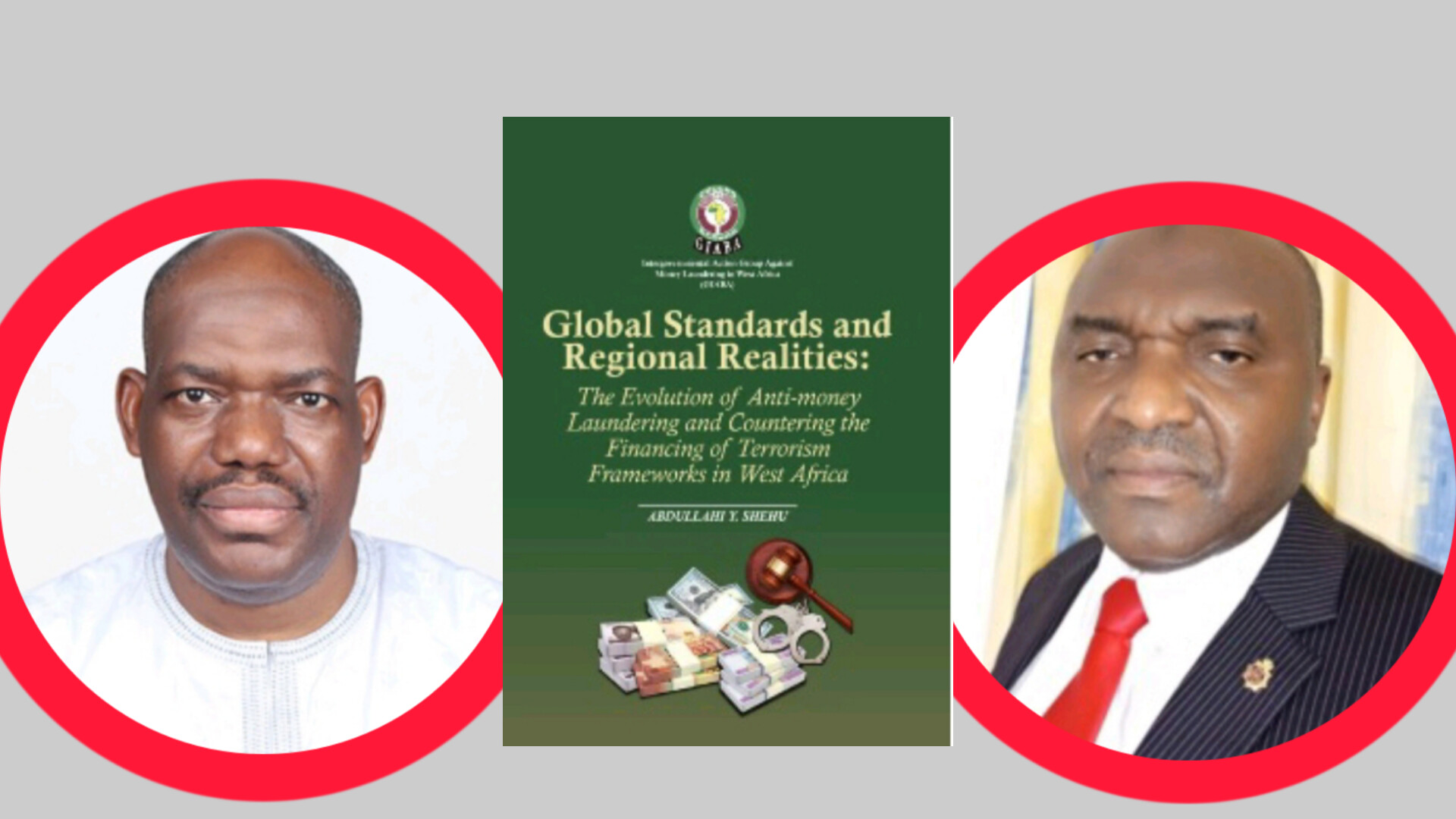
_______________
Book Title: Global Standards and Regional Realities: The Evolution of Anti-Money Laundering and Countering the Financing of Terrorism Frameworks in West Africa
Author: Professor Abdullahi Y. Shehu
Reviewer: Muazu Umaru
_______________
Your Excellency, Madam Vice President of the ECOWAS Commission, Honourable Attorney-General of Liberia,
Distinguished Director-General of GIABA,
Former Directors-General and Deputy Directors-General,
Distinguished Ladies and Gentlemen,
It is with immense privilege and deep personal emotion that I stand before you today to review this remarkable work by Professor Abdullahi Y. Shehu. But before I tell you about this book, permit me to tell you about the man who wrote it – because understanding the author is essential to appreciating the profound wisdom contained in these pages.
A Journey of Twenty-Seven Years
I first met Professor Shehu in 1998. Over these twenty-seven years, I have had the unique privilege – and occasional terror – of working under Professor Shehu’s leadership in various capacities. I had occasional worked with him on specific activities at the EFCC Academy in Karu, Abuja, where I learned that his standards for excellence were not mere aspirations but non-negotiable expectations. Then, during my over ten years of participating in the Commission on Narcotic Drugs meetings in Vienna, when I thought, our paths have separated, there he was again – this time as a UNODC consultant, keeping a watchful eye!
And what an eye it was. But he also had a heart. I will never forget those moments when, sensing our homesickness in Vienna, he would take us to that one Nigerian restaurant in Vienna City. To this day, I can taste that jollof rice – though I’m still not sure if it was the food or the company that made it so memorable. Perhaps both. It was in those moments, away from conference rooms and formal settings, that I truly understood his philosophy: that leadership is not just about setting standards but about bringing people along, making them feel valued, and yes, ensuring they don’t forget the taste of home.
When he invited me to join him at GIABA, I should have known what I was signing up for. Four years of direct reporting taught me that working for Professor Shehu means three things: you will learn more than you ever imagined, you will work harder than you thought possible, and you will emerge transformed. My entire family came to accept him as one of our own, not because we chose to, but because his presence in our lives during critical moments made that acceptance inevitable. When you need wisdom at 2 AM, when you need guidance at crossroads, when you need someone who will tell you the truth even when it’s uncomfortable – that person, for us, has been Professor Shehu.
The Book: Where Vision Meets Documentation
Now, about this extraordinary book. “Global Standards and Regional Realities” is not merely an academic treatise – though it certainly meets that standard with flying colours. It is, fundamentally, a love letter to West Africa, written by someone who has spent decades in the trenches of financial crime prevention, someone who has seen both the magnificent potential and the frustrating realities of our region. The first Ph.D. in Anti-corruption and Money Laundering for a renowned Hong Kong University.
The title itself is brilliant in its honesty: “Global Standards and Regional Realities.” In those five words, Professor Shehu captures the central tension that has defined GIABA’s work for twenty-five years. How do you implement FATF recommendations designed in Paris boardrooms in the context of Dakar markets, Lagos streets, and Monrovia neighbourhoods? How do you talk about beneficial ownership transparency in economies where informality is not a bug but a feature? How do you demand real-time transaction monitoring in places where electricity supply is aspirational?
This book answers those questions not with theoretical flourishes but with the wisdom of lived experience.
Part One: The Foundation
The first part of the book provides a comprehensive overview of the global AML/CFT architecture. But what sets this apart from countless other texts on the subject is Professor Shehu’s ability to explain complex international frameworks without losing sight of why they matter. He doesn’t just tell us what FATF Recommendation 10 says; he explains why Customer Due Diligence principles, born from concerns about Swiss banking secrecy, must be adapted when your customer is a trader in a border town who has never seen a formal identification document.
His treatment of ECOWAS’s evolution is particularly poignant. Reading Chapter 1, I was reminded of our early days, of the optimism that fuelled the creation of GIABA in 2000, of the belief that West Africa could indeed build a robust AML/CFT architecture. The documentation of ECOWAS Vision 2050 alongside the stark realities of current challenges creates a necessary tension – aspirational without being delusional, critical without being cynical.
Part Two: The Heart of The Matter
If Part One lays the foundation, Part Two builds the house – and what a house it is! The chapter on the formation of GIABA (Chapter 6) is titled “Because I Was Involved,” and in that delightful departure from academic convention, we see the real Professor Shehu emerge.
Yes, he was involved. And thank God he was.
His account of GIABA’s formation is part history, part memoir, and wholly essential reading for anyone who wants to understand not just the institutional architecture but the human drama behind it. Having been involved in the review of the law that created the EFCC and the role of Malam Nuhu Ribadu, the first EFFCC Chairman, in pushing for the operationalisation of GIABA brought the memorable nostalgia home, as if it were yesterday. Truly we have grown old.
The politics of statutory appointments in ECOWAS (Chapter 8) should be a required reading for anyone who still harbours illusions about international organisations operating on pure meritocracy. Professor Shehu pulls back the curtain with the kind of honesty that only someone who has survived – and thrived – in that environment can afford.
The section on typologies and research studies demonstrates something I learned during my years working under him: Professor Shehu is fundamentally a teacher. He doesn’t just want to understand financial crime; he wants everyone else to understand it too. His insistence on conducting typology studies, even when donor funding was scarce, even when member states were lukewarm, reflected his deep belief that knowledge is the foundation of action. He chose me to lead that charge as the acting head of the Research, Monitoring and Evaluation Division in 2010 – stepping aside from pursuing criminals to pursuing knowledge and understanding – a task I have never regretted taking on till today.
Part Three: Vision Meets Action
The third part of this book is where Professor Shehu takes off the academic cloak entirely and speaks from the heart. “Reflections and Lessons Learned” could have been a self-congratulatory victory lap. Instead, it is a masterclass in honest reflection.
His articulation of core values – integrity, courage, inclusivity, excellence – is not presented as abstract ideals but as hard-won principles forged in the fire of actual leadership challenges. When he writes about integrity, he’s not quoting a management textbook; he’s remembering specific moments when taking the easy path would have been so much simpler and explaining why he didn’t.
The chapter on his evaluation as Director-General (2006-2014) could have been omitted. Most authors would have left it out, concerned about appearing self-serving. But its inclusion is vintage Professor Shehu: if there’s data, present it; if there’s feedback, learn from it; if there’s a story that might help others, tell it. The evaluation reveals what those of us who worked with him already knew – that his tenure transformed GIABA from a promising idea into a respected institution.
A few weeks ago, while reviewing this book and adding some value to it, I checked my archives and came across a letter Professor Shehu requested me to draft for him to the then President of the ECOWAS Commission. I went over his edits. I was too diplomatic. He wanted to make his point straight – conveying a disagreement succinctly and sharply – all based on principles and facts. It was another nostalgic moment for me – a poignant reminder that men of higher ideals never waiver.
The Humor in The Gravitas
Now, I must address something that anyone who knows Professor Shehu will find amusing about this book: it is remarkably serious. Pages and pages of financial action task force standards, mutual evaluation methodologies, immediate outcomes, technical compliance ratings – all presented with the earnestness of someone who genuinely believes these things matter.
And here’s the thing: he’s right. They do matter.
But having worked with Professor Shehu, I know there’s another side to him – the side that would, in the middle of a serious meeting about FATF recommendations, suddenly ask if anyone had read Recommendation 23 recently because, and I quote, “I’m not sure even the FATF remembers what they wrote.” The side that could diffuse tension in the most fraught negotiations with a perfectly timed observation about the absurdity of our collective situation.
That humour doesn’t make it into the book much, which is probably appropriate for an academic text. But I mention it here because it’s an essential part of understanding how Professor Shehu has been so effective. He takes the work seriously without taking himself too seriously – a rare and valuable combination. When he has done his best, he will normally forget it and move on!
What This Book Really Is
Strip away the chapters and footnotes and citations, and what you have here is a chronicle of possibility. Professor Shehu is documenting what many said was impossible: that West Africa could build credible AML/CFT systems, that GIABA could become a respected FATF-Style Regional Body, that our member states could improve their technical compliance and effectiveness despite enormous constraints.
The book is also a warning. In his conclusion, Professor Shehu writes about the fragility of the gains made over twenty-five years. He notes, correctly, that political commitment to AML/CFT is not a permanent state but must be constantly renewed. He worries – and his worry is well-founded – that donor fatigue, shifting priorities, and the sheer difficulty of the work might cause backsliding.
But most importantly, this book is a call to action. It is Professor Shehu’s way of saying: “This is what we’ve built together. This is why it matters. This is what we must do next.”
A Personal Reflection
Reading this book was, for me, like walking through a museum of my own professional life. Every chapter triggered memories: late nights preparing for plenary meetings, the anxiety before mutual evaluations, the small victories and occasional setbacks. I found myself in these pages – not by name, but in the collective “we” that Professor Shehu invokes when describing GIABA’s work.
And that is perhaps his greatest gift as a leader and as an author: he has always made his work our work. He has never claimed sole credit for GIABA’s achievements because he understands that institutions are built by teams, by dedicated staff members, by committed member states, by individuals who show up day after day to do unglamorous work that rarely makes headlines but slowly, steadily changes reality.
When he writes about those who are “on the frontlines of the fight against financial crime,” he is writing about people like me, like many of you in this room, like countless unnamed compliance officers and financial investigators and regulators across West Africa. This book is as much theirs as it is his.
The Verdict
Is this book perfect? Of course not. Professor Shehu himself would be the first to point out areas that could be expanded, arguments that could be strengthened, data that could be updated. That’s who he is – perpetually dissatisfied with good enough, always reaching for better.
Is it comprehensive? Remarkably so. From the Vienna Convention to the Yaoundé Declaration, from the FATF 40 Recommendations to ECOWAS legal frameworks, Professor Shehu has created what amounts to an encyclopedia of AML/CFT in West Africa.
Is it readable? Honestly, if you’re looking for beach reading, this is not it. But if you want to understand how global financial standards intersect with regional realities, if you want to see what two and a half decades of institution-building looks like, if you want to learn from someone who has not just studied financial crime prevention but lived it – then yes, this book is eminently readable and deeply rewarding.
Is it important? Absolutely. Twenty-five years from now, when researchers want to understand how West Africa responded to the challenge of money laundering and terrorism financing in the early 21st century, they will turn to this book. It is the definitive account, written by someone who wasn’t just a witness to history but a maker of it.
Looking Forward
As GIABA celebrates its 25th anniversary, this book arrives at the perfect moment. It allows us to look back with clear sight at what has been accomplished while looking forward with determination at what remains to be done.
Professor Shehu ends his book by quoting the African proverb: “If you want to go fast, go alone. If you want to go far, go together.” GIABA’s twenty-five years prove that we have chosen to go far, together. This book is both a celebration of that journey and a roadmap for the next leg.
Conclusion: A Word to The Author
Professor Shehu, sir, when you invited me to join GIABA in 2007, and eventually arrived in April 2009, you promised me that it would be challenging. You were right – it was brutally challenging. You promised me that I would learn. You were right – I learned more than I could have imagined. What you didn’t tell me was that I would gain not just a boss but a mentor, not just a mentor but a guide through some of life’s most critical moments, not just a guide but someone my family would come to regard as one of our own.
This book is worthy of you – which is high praise indeed. It combines your intellectual rigor with your practical wisdom, your attention to detail with your big-picture thinking, your respect for institutions with your understanding that institutions are ultimately about people.
You have given West Africa a gift in this book. But more than that, you have given us the gift of your leadership, your vision, and your unwavering commitment over decades. Those of us who have had the privilege of working with you, of learning from you, of sharing Nigerian meals in Vienna, countless diplomatic invitations to your official residence for official occasions – dinners and lunches, the many weeks without weekends, and late-night strategy sessions in Dakar, Cambridge and in Paris, of seeing you provide leadership at critical moments – we know that this book, comprehensive as it is, captures only a fraction of your contribution.
Thank you for writing it. Thank you for living the life that made it possible to write it. And thank you for bringing so many of us along on the journey.
Final Recommendation
To the current and future leaders of GIABA, to policymakers across West Africa, to students of financial crime prevention, to anyone who wants to understand how regional institutions can drive meaningful change despite daunting constraints – read this book.
Not because it’s perfect, but because it’s true.
Not because it’s easy, but because it’s necessary.
Not because Professor Shehu needs our validation, but because we need his wisdom.
Ladies and gentlemen, I present to you “Global Standards and Regional Realities: The Evolution of Anti-Money Laundering and Countering the Financing of Terrorism Frameworks in West Africa” by Professor Abdullahi Y. Shehu – a book whose time has come, written by a man who has given his time to making our region safer, more transparent, and more just.
It is, quite simply, an essential reading. May this contribution be an inspiration for many generations of AML/CFT practitioners in West Africa.
Thank you.
_______
The review was delivered At the GIABA 25th Anniversary Celebration held at Farmington Hotel, Unification Town, Margibi County, Liberia on November 21, 2025
Reviewer Bio:
Muazu Umar has worked in counter-narcotics, anti-money laundering and counter-financing of terrorism for close to three decades at the National Drug Law Enforcement Agency, Nigeria and GIABA. He served under Professor Shehu’s leadership at personal level, at the EFCC Academy (ad hoc) and GIABA (permanent), where Professor Shehu was his direct supervisor. A trained counter-narcotics officer with expertise in international organised crime, has represented both Nigeria and GIABA at numerous international forums, including the UN Commission on Narcotic Drugs in Vienna, the Interpol, Financial Action Task Force and many others. He was recently appointed to serve as the Acting Secretary General of the ECOWAS Commission by the President of the Commission.