


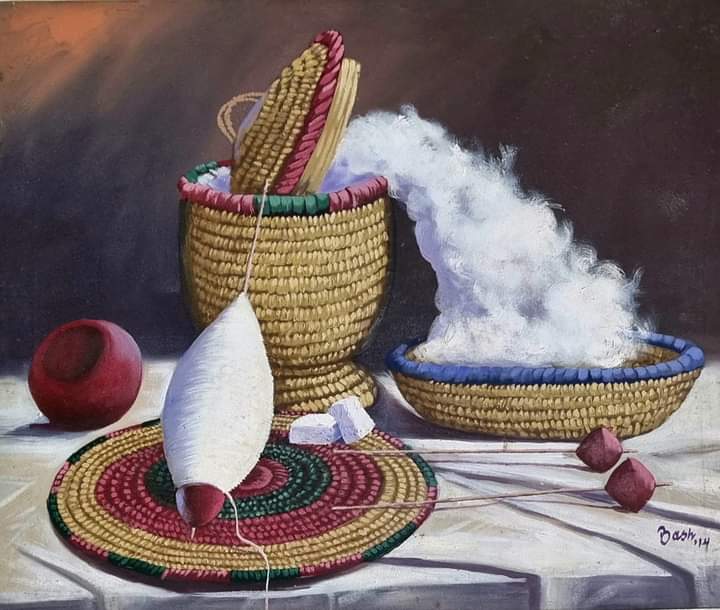
Lost Heritage Series #1 – Mazari [Spindle]
By Abdalla Uba Adamu
Related posts


I count myself lucky to appreciate art since I was a child. The large format artbooks in the Abdullahi Bayero College Library where I used to accompany my dad in the mid-1960s (with Biafran war and all) who was then a student provided endless sources of fascination and beauty. I even briefly studied art technique under a fellow student during secondary school days, but unfortunately not enough before we all parted to see each other no more. Subsequently, I surround myself with various size canvases whenever I can. My art focus on mainly landscapes and objects, rarely people.
Currently in my personal office hangs three canvases containing images of stunning beauty painted by Bashir Isah Abbas, a lecturer in the Department of Art, Kano State Polytechnic. One of them, which I am sharing today in the series, is a photorealistic portrait of a lost heritage: mazari, or spindle, used to create threads mainly by women. The threads are then sold to textile weavers who will create fabrics of stunning beauty, design and durability. Long before Austrian Getzner.
A traditional textile weaving device, the mazari was an effective instrument in the hands of our grandmothers. Granma (Nana, Yaya, Iya, Fulani, etc.) would be spinning the mazari with the cotton flowing behind it, and weaving it to produce threads that will eventually be used to create an exceptional fabric by local weavers. And accompanied by a song rendered in her beautiful voice. Yes, I was lucky to experience my grandmother weaving with the mazari, and I was the one always going to Mandawari market to buy the fluffy soft cotton before she passed away in 1963. This painting, therefore brought back a rush of memories of Fulani Hauwa, my grandmother.
Colleen Kriger, who has done extensive research on cotton textile production in northern Nigeria, has this say about mazari in Sokoto:
“Women’s work as spinners, noted in the literature and clearly important, has not been a subject of study and is often described in negative terms. Compared to treadle-operated spinning wheels, the spindle (Hausa mazari) used for hand spinning in the Sokoto Caliphate is indeed a simple tool; but as with most so-called ‘simple’ tools and machines, a high degree of control and skill had to be acquired by the worker in order to produce a consistent or high quality product. My analyses of nineteenth century textiles show that spinners did acquire a high degree of skill, their work was specialized, and their skill and specialization were acknowledged by consumers. I found little evidence of breakage. The dimensions of yarns were in many cases very fine, and the twist was consistently even. The type and quality of yarn used in the cloth was one important factor that could help weavers and brokers negotiate higher prices and higher profit margins.” (pp. 382-3). Kriger, Colleen. “Textile Production and Gender in the Sokoto Caliphate.” Journal of African History, 34 (1993), pp. 361-401.
With industrialization of textile production, of course, the mazari has virtually disappeared. For hundreds of years, though, it provided a fundamental unit of civilization – through clothing us, a process that separated us from primitive savages. Feast your eyes on an icon of Muslim Hausa civilizational effort.
If you are lucky to have a Grandma in the house, ask her to regale you with the tale of the mazari and textile production in her younger days. You will learn a lot about how industrious Hausa women have always been.
This picture is mine, although somehow it has found its way into some blogs. Here it is, full and with no watermark. Feel free to share it as part of our disappeared heritage.
~~~~~~~