

Sule Lamido’s Theme of Authenticity
By Bukar Usman
Related posts


__________
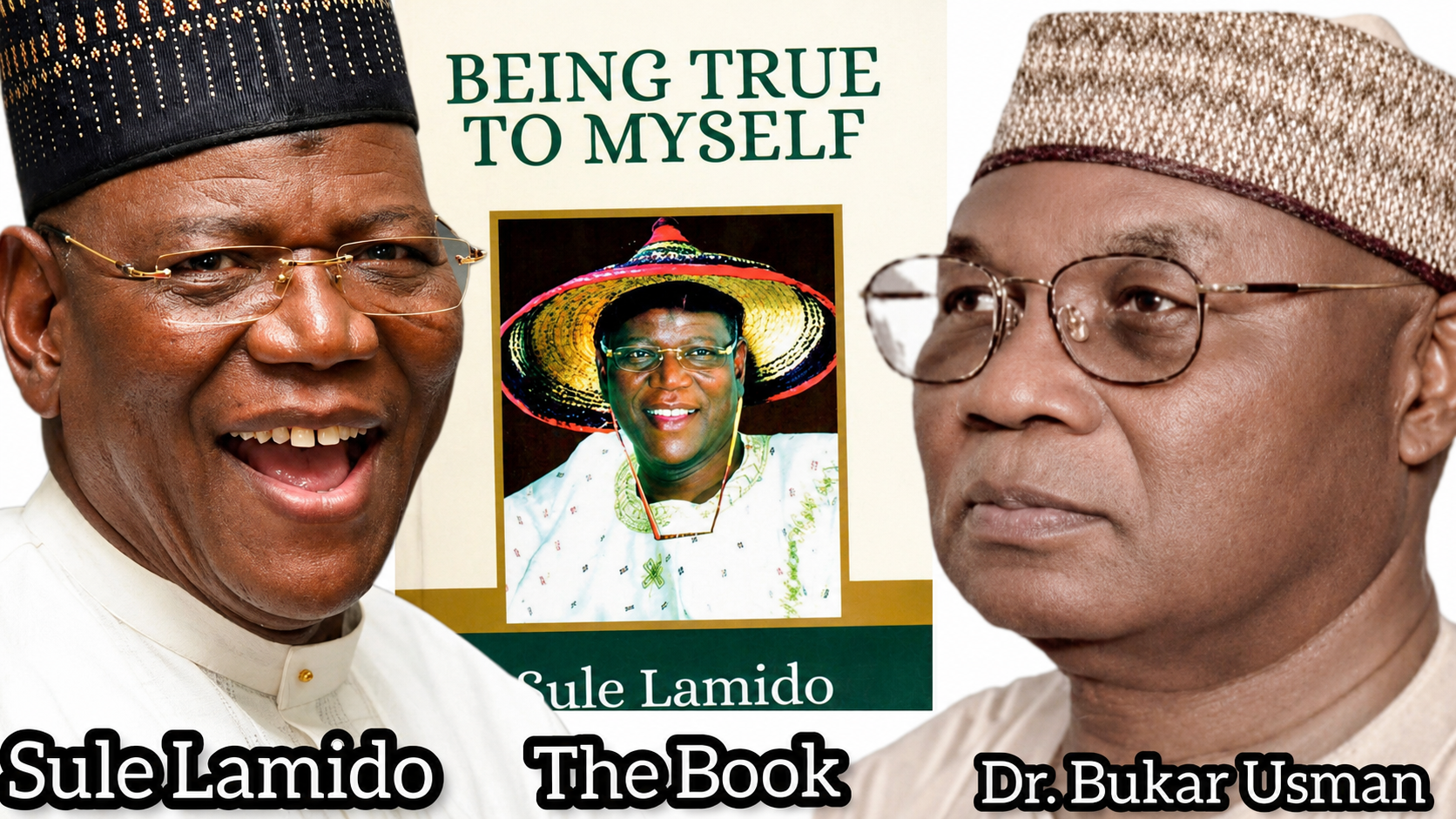
Book Title: Being True to Myself
Author: Sule Lamido
Year of Publication: 2025
Number of Pages: 487
Reviewer: Bukar Usman
__________
The title of Sule Lamido’s autobiography, Being True to Myself, is a huge statement in itself. It talks about the need to be the real you. Being true to yourself is about the necessity of expressing yourself in consonance with your own innate qualities, values and desires. Someone is said to be true to himself when his personal wellbeing arises from a conscious awareness of personal meaning and purpose in life. This happens when one is habitually committed to developing a sense of personal responsibility that makes him act out of self-conviction rather than out of pure affectation or imitation.
Being true to one’s self is not following the crowd mindlessly but following one’s inner and authentic convictions. It also means finding something worthwhile and personally fulfilling in the social landscape to live for. It is being committed to what one is convinced he is called to do for the betterment of his society. This is why Aristotle said that a meaningful life is an authentic life. An authentic life is one in which deeply ingrained moral values (like fellow feeling, generosity, integrity, tolerance, and justice) drive and regulate one’s daily behaviour.
The foregoing is my general understanding of the phrase, “being true to myself”, which Sule Lamido, former Governor of Jigawa State and former Minister of Foreign Affairs, has chosen as the title of his autobiography. Although a team of five led by Professor Haruna Wakili of blessed memory impressively edited the 487-page book, the team unequivocally asserts that the views and opinions expressed therein are solely those of the author.
Lamido states that although he was born into a life of affluence, he grew up with a “tenacious empathy towards the less-privileged,” noting that small as his hometown, Bamaina, is, “inequalities in social and economic status were visible.” Indeed, he recalls that as a child his sense of empathy extends to even animals such that he could not stand the sight of a baby goat crying; he would also start crying (p.14). Perhaps, that empathy and concern for the downtrodden is what made him a long-standing “constructive critic,” one that not only points out errors in the way Nigerians are governed but also suggests ways of correcting identified flaws (p.379).
Reports of Lamido’s various encounters in and outside Nigeria with personalities in and out of governance at different levels are profusely reproduced in the book as if Lamido went about with a tape recorder or verbatim reporter.
The foregoing suffices as a brief introduction to the personality of Lamido. It may be further elaborated by his choice of partisan political affiliations and activities.
The 487 pages long book, is divided into 8 parts and has 16 chapters. As expected, the book narrates the life and times of Lamido. The entire contents could be simply divided broadly into 3:
• Birth and pre-partisan political involvement
• Partisan political involvement
• Conclusion
A. Birth and Pre-partisan Political Involvement:
This segment of Lamido’s life is narrated at pp 1-47. He is of Fulani stock as indicated by his portrait on the book cover wearing a typical Fulani ‘malafa’ (hat) made of decorated raffia. He speaks Fulfulde. However, Hausa is the lingua franca of the family.
Lamido was born on August 30, 1948 at Bamaina, a Fulani settlement established by his grandparents around 1904; that was a decade before the amalgamation of the Southern and Northern Protectorates by the British to form Nigeria. Bamaina situated along Kano- Maiduguri Road, route A237, hitherto in Kano State is now in Birnin Kudu Local Government of Jigawa State. It has evolved into a District that has been ruled by his forebears since the establishment of the settlement. Although Lamido is a prince, he did not offer himself as a District Head on account of his full-time preoccupation with partisan politics. One of his children is now the District Head. Bamaina is Lamido’s sanctuary.
Though Lamido started his educational pursuit in an Islamic school as a child, formal education took him from primary school in nearby Birnin Kudu town to Government College Zaria now Barewa College. His admission in 1961was purely based on his brilliance. He was proudly conspicuous and fashionable at the College.
After graduation from Barewa College, Lamido first secured appointment in the Nigerian Railway as a civil engineer trainee in 1967. He lost interest and secured another employment with the Nigerian Tobacco Company (NTC) as Quality Control Inspector. He was posted to Gusau and subsequently transferred to Maiduguri. His third job was as a Marketing Manager at AC Christilieb. While in that employment he was transferred to Lagos in 1974.
Lamido’s sojourn at Barewa College with its philosophy of non-discrimination on grounds of religion and ethnicity, coupled with his travels to other parts of the country as a salesman of private companies, broadened his mind on Nigeria’s diversity and made him imbibe pan-Nigerian perspective and outlook.
B. Partisan Political involvement:
This segment of Lamido’s life is extensively discussed in the bulk of the book from pp.50-406. The narratives cover his associates in Lagos while working for the private company. Through discussions with those associates often at his place of residence, he got an insight into the philosophy of the Northern Elements Progressives Union (NEPU) in particular that later metamorphosed into the People’s Redemption Party (PRP) and part of the nucleus that subsequently formed the Nigeria People’s Party (NPP) and the People’s Democratic Party (PDP).
Lamido joined partisan politics through the PRP in 1979. The ideology of NEPU, values and principles of concerns for human dignity and well-being, which tallies with his personal convictions, have since been his guiding philosophy in politics and governance (p.409). Though the platform may change, he says, he remains ever faithful to the NEPU ideology that he strongly believes in and practices to date.
i Parliamentarian: Lamido was elected on platform of PRP to the Federal House of Representative where he represented Birnin Kudu, then in Kano State, from 1979-1983. As a parliamentarian, Lamido was a member of the Movement for the Creation of Jigawa State. The quest was realized and he was subsequently elected Governor of that State.
ii Party Official: Politics paid Lamido off with several appointments. In Social Democratic Party (SDP), he held the post of Party Chairman Kano. He subsequently served as National Secretary of the Party. He faced the usual intra-party factional squabbles before and after being elected as the Chairman. The National Secretary post was no different.
Lamido does not support party primaries for selections of candidates aspiring for political offices. This, he says, is on account of monetization under the prevailing hunger and poverty as well as the low level of awareness on the part of delegates. He maintained that though primaries seek to democratize the selection process, the outcome compromises the ideals and objectives of the process. Lamido prefers the old-fashioned practice where the party leadership exercised the prerogative of nominations of candidates.
The author recounts his personal travails and that of his family caused mainly from his stance on issues and attempts at the presidential post in particular. He was imprisoned twice and was detained for security reasons 8 times in his political life. Among the challenges he experienced as party official, was the June 12, 1993 presidential election annulment crisis where in spite of stiff opposition he stood firm on decisions that ensured national unity, peace and stability above other consideration.
iii Corporate Chairmanship: Lamido was appointed Chairman of the Nigerian Agricultural and Cooperative Bank (NACB) under the Abacha Administration. The bank was under the supervision of the Ministry of Agriculture. He held the post for only three months before proceeding as a delegate to the National Constitutional Conference. He says that the Chairmanship of the bank was the first position he ever held in government and that it introduced him to the inner workings of government. Narrating his experience there and later at the Ministry of Foreign Affairs where he was appointed as Foreign Minister under the Obasanjo Administration, he says that he tried as much as possible in those positions to distance himself from ‘sleaze’ and ‘material temptation’ so as not to compromise in any way his integrity and exercise of moral authority over those he presided. For that same reason while he was at the Ministry of Foreign Affairs, he retired any unspent upkeep money given to him for his overseas official duty tour (pp.160-166).
iv Constitutional Conference Delegate: Lamido was a delegate at the National Constitutional Conference of 1994/1995. He found initial discussions at the Conference highly emotional among the various participating interest groups. Recommendations were made after emotions cooled down. He found the Conference as a forum for formation of political alliances.
v Ministerial Portfolio: Lamido was appointed Foreign Affairs Minister from 1999-2003. He refused to sign undated letter of resignation given by the presidency to each Minister that was appointed by that administration.
Lamido understood his portfolio as mainly to explain Nigeria’s actions and events. Hence, upon assumption of office, he drove home the point to the staff that there should be no pretenses, urging them to showcase Nigeria as it was and not what the outsiders wanted it to be.
As one of his priorities, Lamido improved the working environment and enhanced the status of the Ministry. He resolved to complete the construction of the Ministry’s headquarters building in Abuja that had been abandoned for nearly a decade. Fortunately, he succeeded in doing so with the support of the presidency, in spite of attempts to question his integrity and moral authority in the process. Situated near the Eagle Square, the building was on completion named in honour of the first and only Prime Minister of Nigeria, Sir Abubakar Tafawa Balewa.
As Lamido faced the outside world interacting in bilateral discussions with counterparts and in multilateral conferences, he firmly defended Nigeria against some of the hypocritical policies being advanced by some foreign countries. Among these were declining to support draft resolutions condemning the leadership of some countries under sanctions, notwithstanding the enormous harm the sanctions were inflicting on the common people. He was outspoken on non–redemption of pledges of money to developing countries e.g. pledges made at the famous Lome Convention.
On poverty and hunger, he would rather invite all concerned to visit his country and see its deplorable condition than engage in fruitless discussions overseas. He was also a strong advocate for debt forgiveness and return of looted funds to Nigeria. Nigeria benefitted from a renegotiation of its foreign debts as a result of those efforts. The Ministry under his watch did not subscribe to the attitude of double standards of some countries that condemn the application of Sharia laws in some countries while overlooking their application in other countries.
vi Gubernatorial Portfolio: Lamido succeeded in being elected consecutively as two-term Governor of Jigawa State, between May 29, 2007 and May, 2015 after unsuccessful attempts to vie as Governor of Kano State before Jigawa State was created. His election as Governor of Jigawa State also came about after several attempts were subverted.
Upon assumption of Office as Governor, he worked to uplift the physical structures and quality of human capital in the State. In doing so, he centralized the ministries in Dutse, the State capital. The ministries were previously located in various emirates. He also restored the Civil Service Commission.
To lay the foundation for peace as prerequisite to development and facilitate the achievement of his policies, Lamido enlisted the support of the State legislature and elite. He also embarked on social orientation to minimise issues that cause misunderstanding and upheaval among the citizens. In the face of low Internally Generated Revenue (IGR), Lamido secured the support of the international aid agencies for his social projects, thus complementing the finances from the monthly Federation Account Allocations.
Lamido found education in the State was particularly in a deplorable situation. For three years, he said, no candidate from Jigawa State went to tertiary institutions because the previous Government failed to pay N10million examination fees to the National Examination Council (NECO). However, by his 5th year in office funding education had by far exceeded the United Nations Educational, Scientific and Cultural Organization (UNESCO) – recommended minimum 25% allocation from the State budget. The State allocated about 30% to redress the situation (pp.310 & 316).
At the end, Lamido succeeded in the execution of some land mark projects in education, health and other critical sectors he tackled. The book contains impressive pictures of some of his legacies in that regard. They include Jigawa State University renamed Sule Lamido University; School of Nursing and Midwifery; Skills Acquisition Centre; government offices and housing estates to reduce accommodation problems faced by public officers and an international airport. To receive feedback from the public regarding his performance in execution of those projects and other policies, Lamido threw open his telephone line for access at all times. Indeed, he says, this has been his policy while he holds public office.
C. Conclusion:
The concluding Chapter records Lamido’s gratitude to God for guiding him through his largely successful political journey. Apart from his not being elected president of Nigeria, he succeeded in winning other political offices he sought for. Having been a Governor, he says, it was never his desire to condescend to vying for a senatorial seat, unlike some of his former colleagues. He held the office of Governor in high esteem and never wanted to do anything that lowers that status in the eyes of the public. Lamido at 77 remains committed to partisan politics and to PDP, in spite of the latter’s current political challenges. His profile as a principled national figure and moral voice has been recognized in different ways, including Federal University of Agriculture Abeokuta’s conferment of Honorary Doctor of Philosophy degree on him. He was one of the PDP’s founding members called the Group of 9 notable politicians (G9) that teamed-up during the Abacha administration purposely to see off the military from governance.
__________
Dr Bukar Usman, OON, former permanent secretary in presidency and current president of the Nigerian Folklore Society May 18, 2026.